
How do we make it work?
Home practice between online speech therapy sessions
Home practice is short, guided practice between sessions, set and checked by the speech pathologist. What it looks like for...
Toddlers And Late Talkers
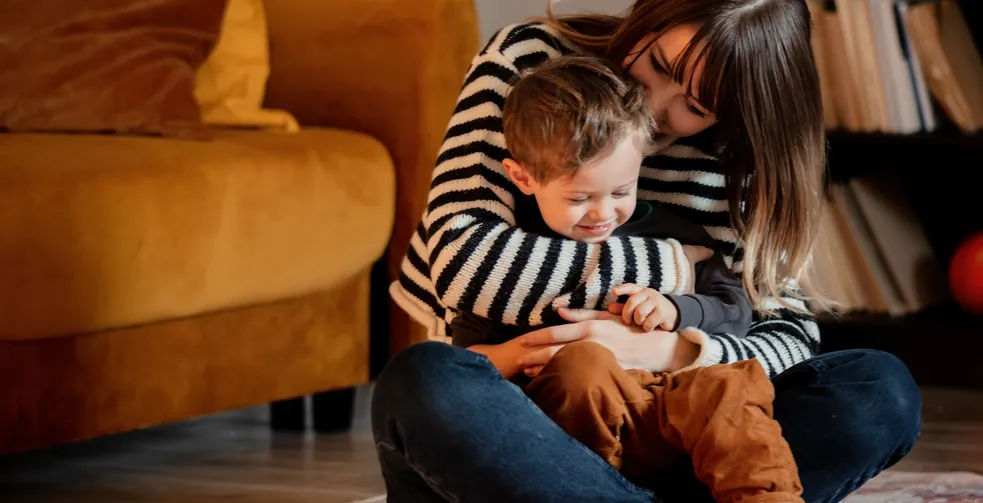
Online speech therapy can work with a two or three year old because your toddler is not asked to sit at a screen. Dr Lauren Crumlish (PhD), a Certified Practising Speech Pathologist, watches you and your child play by video and coaches you in the moment. The strategies are learnt in your own home, with your child's own toys.

The short answer
With a toddler, online speech therapy is mostly parent coaching. A phone, tablet or laptop is set up so it can see the play space, and you play with your child as you normally would. Dr Lauren watches the play, points out what your child is doing and gives you the next thing to try. Your toddler does not have to look at the screen or talk to her.
Dr Lauren leads the therapy. She assesses your child, sets the goals, chooses the strategies, watches how your child responds and changes the plan as your child progresses. Your part is to use the strategies in play and everyday routines, with her guidance in every session.

On Video
A toddler session is built around play on the floor, not a child at a desk. This is what it usually involves.
A device propped up where it can see you and your child, loud enough for you to hear Dr Lauren
Your child's own toys, books or a snack, chosen because your child already enjoys them
You playing with your child while Dr Lauren watches how your child communicates: sounds, gestures, looks and words
Short pauses where Dr Lauren explains what she noticed and suggests one thing to try, then you try it
Your child free to move, wander off and come back, while Dr Lauren keeps coaching you
Time to ask questions and agree what to try before the next session
Toddlers learn to talk in everyday back and forth with the people they spend the most time with, not in a lesson. That is why speech therapy for toddlers is usually built around coaching a parent, and why the model suits video so well. Dr Lauren sees your child where they are most relaxed, in the routines where new words will be used: play, books, meals and getting ready to go out. You learn a strategy by doing it with your own child while she watches, rather than by watching someone else do it.
With three and four year olds and other preschoolers, Dr Lauren may also work more directly with the child as they become able to take turns with her on screen.
The screen is for you, not your toddler. A coached session is not screen time in the usual sense, because your child is playing with you, not watching a device. Attention, wandering off and screen use are covered in full in the guide will my child sit still for online speech therapy? What you need at home is on technology and set-up.
Dr Lauren is trained in It Takes Two to Talk, The Hanen Centre's program for parents of toddlers who are slow to start talking. Parents learn to notice how their child communicates, what motivates them to communicate, and how to follow their child's lead and build turn taking into daily routines, play and book reading.
Hanen's own format is a parent course that mixes group meetings with a few individual visits, and Hanen lists it as available in person or online. By video, the Hanen strategies are coached live in your own play, one family at a time: Dr Lauren watches you try a strategy with your child on camera and talks through what happened while it is still fresh, so nothing has to be translated from a group to your child.
Hanen describes It Takes Two to Talk as a program for children who are not autistic. If you think your toddler may be autistic, see online speech therapy for autistic children.
Between sessions you use the strategies in the routines you already have, such as playing, reading together, meals and bath time. Dr Lauren shows you what to do and why, and at the next session she asks how it went, watches it again and decides what to change. How much practice to aim for is set by Dr Lauren for each family. The guide to home practice between online sessions explains how families fit it into a busy week.
The research on telehealth for children under three is encouraging but small. A 2025 systematic review in the Journal of Medical Internet Research found 18 studies of telehealth early intervention for children aged 5 to 37 months with developmental disabilities, mostly autism or cerebral palsy, almost all delivered by live video. Half of the studies targeted communication. Where telehealth was compared with in-person help, outcomes were comparable, and in most studies that measured it, parents learnt to use the strategies as intended.
The limits matter. Most of the 18 studies followed a few children each in single-case designs, and eight had six or fewer participants. Only four were randomised trials, and the reviewers could not combine the results into one measure of effect. Few studies were about late talkers specifically, so the review says more about the coaching format than about results for a late talker. The research across all ages is set out on does online speech therapy work?
Some toddlers need a check that cannot be done by video before speech therapy starts, or alongside it.
| Situation | Where to start |
|---|---|
| Your child's hearing has not been checked, or you have doubts about it | Ask your GP for a hearing check with an audiologist |
| Your child has lost words or skills they used to use | See your GP or child health nurse promptly |
| Eating, drinking or swallowing is a concern | Your GP, and a speech pathologist who sees feeding in person |
| You are worried about more than talking, such as movement, play or how your child relates to people | Your GP, who may refer you to a paediatrician |
Healthdirect suggests seeking advice if a child is not trying to communicate by 12 months, or is not saying about 50 words or starting to join words by two. The full list of when in-person help is the better choice is in is online speech therapy right for my child?
If your toddler talks but gets stuck on words, repeats sounds or stretches them out, that is a different kind of work. See can stuttering be treated by video?
Step By Step
Every family starts with an assessment, held by video like every session.
Tell us about your toddler in the application form. Our team will review your application.
Dr Lauren assesses how your toddler communicates through play and through your account of their development, and agrees the goals with you.
In each 45 minute session you play with your child while Dr Lauren coaches you, and she adjusts the plan as your toddler's communication grows.
You use the strategies in everyday routines, and Dr Lauren reviews how it went at the next session.
Fees
For a late talker, the Short Assessment is usually the starting point. Therapy is charged per session.
Therapy
One hour of service: 45 minutes of therapy by video, and 15 minutes of preparation and notes
$193
Every family starts with an assessment
$590
Usually for late talkers, stuttering and speech clarity
$890
Usually for school-age language, literacy or social communication
$1,290
Usually for both language and literacy in a school-age child
Medicare rebates are available with a doctor's referral, and private health may apply. Online Speech Therapy is not a registered NDIS provider: self-managed and plan-managed participants are welcome, and NDIA-managed funding cannot be used. It is not a Thriving Kids provider. See fees in full
Questions Parents Ask
Telehealth for children under three has promising but limited evidence. A 2025 systematic review of 18 studies of telehealth early intervention for children under three with developmental disabilities, mostly autism or cerebral palsy, found outcomes comparable to in-person help where the two were compared. Most studies were very small, though, and only four were randomised trials. For toddlers, telehealth works through coaching the parent while the child plays.
Your toddler does not need to sit in front of the screen. In an online session with a toddler, the device faces the play space and Dr Lauren coaches you, the parent, while your child plays, moves around and comes and goes. If your child does wander off, that is part of the session, not the end of it.
The Hanen Centre lists It Takes Two to Talk as available in person or online, run as a course of parent group sessions and individual sessions. Dr Lauren Crumlish is trained in It Takes Two to Talk. She brings it into your family's own video sessions, one to one, at the usual $193 session fee.
A child does not need to have a set number of words before speech therapy can help. Healthdirect advises seeking advice if a child is not trying to communicate by 12 months, or is not saying about 50 words or joining words by two. Because the parent is coached, online sessions do not depend on how long a toddler can attend to a screen.
A hearing check is a sensible first step for any toddler who is late to talk, because children need to hear sounds clearly to learn to say them. A hearing test is done in person by an audiologist; ask your GP to arrange one. It can happen before or alongside online speech therapy.
You do not need a referral to apply or to start. A doctor's referral is only needed if you want to claim a Medicare rebate for the sessions.









Work With Dr Lauren
Dr Lauren works with a small number of families and has limited availability. Tell us about your child, and our team will review your application.
Apply Now