
How do we make it work?
Home practice between online speech therapy sessions
Home practice is short, guided practice between sessions, set and checked by the speech pathologist. What it looks like for...
Stuttering, Online
Yes, stuttering can be treated online for many children, and for preschoolers it has been tested against clinic visits in a randomised trial. Dr Lauren Crumlish (PhD), Certified Practising Speech Pathologist, checks the week's severity ratings and watches parent and child talk on camera in every session with a young child, then sets the plan for the week ahead. With a teenager, she works with them directly.

The short answer
In the Lidcombe Program, a speech pathologist trains and supervises the parent, and the practice happens in everyday conversation at home. A video call lets Dr Lauren see and guide it there.
No treatment can promise that stuttering will stop.
On Video
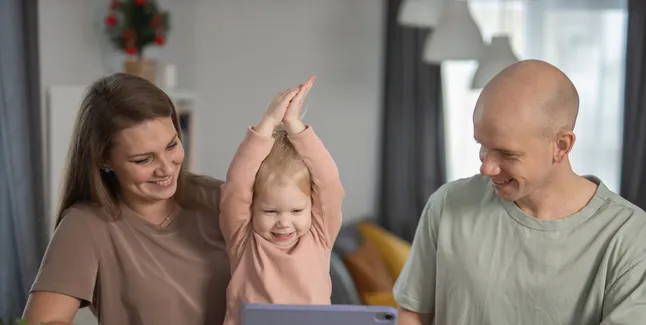
An online stuttering session for a young child follows the pattern the Lidcombe Program guide sets out, held on a video call instead of in a clinic. The parent's part between sessions is short, guided practice, shown step by step.
Dr Lauren reviews the parent's daily severity ratings for the week, a simple score for how the child's talking went each day
She watches the parent and child talk on camera and checks the ratings against what she hears
She shows the next step of the feedback with the child on screen, then the parent tries it while she watches
She sets the plan for the coming week and changes it when the ratings say so
Stuttering treatment for preschool children suits video because the person being coached is the parent, and the parent is at home. In the Lidcombe Program, a treatment developed in Australia for children under six, a speech pathologist trains, guides and supervises a parent to give short, positive feedback on the child's talking during the day. The program's guide states that it is not designed for parents to use without a clinician.
That shapes how Dr Lauren uses the session. She watches parent and child talk together on camera, in their own lounge room, with their own toys and books. She can see how the feedback is going in the setting where it will be used all week, which a clinic room cannot show.
For preschool children, treating stuttering by video has been tested against clinic visits. A randomised trial with 49 children aged three to five found no evidence that webcam treatment did worse than clinic visits on stuttering nine months later (Bridgman and colleagues, 2016). Parents in both groups rated their relationship with the speech pathologist much the same.
For school-age children the evidence is thinner. A 2024 trial by video with 37 children aged 6 to 12 had no comparison group, and about a third of the children had very low stuttering within 12 months (Johnson and colleagues). For teenagers there is less again: one small 2012 Australian trial treated three teenagers entirely by webcam (Carey and colleagues). The rest of the evidence is set out on does online speech therapy work?
The age of the child changes who sits at the screen.
| Age | Who is on the call | What Dr Lauren does |
|---|---|---|
| Preschool (under 6) | A parent and the child together, playing or reading | Coaches and supervises the parent, and checks progress through the daily ratings |
| School-age (6 to 12) | The child, with a parent nearby when needed | Works with the child directly and chooses the approach after the assessment |
| Teenagers | The teenager on their own | Works with the teenager directly; the approach is chosen after the assessment |
Teenagers often find video easier than a clinic: no waiting room, and no time out of school to travel. The teenagers page covers how sessions run without a parent in the room. A toddler who is late to talk as well as stuttering may also need the toddlers and late talkers page.
While you wait, Australian public health guidance gives parents a few safe steps.
Some public services ask parents to keep a daily severity rating while they wait, once a speech pathologist has shown them how. These steps come from NSW Health's guide for parents and the Better Health Channel.
In-person help is the better start when a child cannot take part in a video call even with a parent beside them, or when another concern needs a hands-on check first. The full list is in the guide is online speech therapy right for my child? How a session runs from start to finish is on how online speech therapy works, and every family starts with an online speech and language assessment.
Step by Step
Online Speech Therapy is an online service: every session is by video.
Tell us about your child in the application. Our team will review your application.
Every family starts with an assessment; for stuttering it is usually the Short Assessment.
Each session is 45 minutes of therapy by video.
Short, guided practice at home, shown step by step.
Fees
The Short Assessment ($590) is usually the one for stuttering. Ongoing sessions are charged per session.
Therapy
One hour of service: 45 minutes of therapy by video, and 15 minutes of preparation and notes
$193
Every family starts with an assessment
$590
Usually for late talkers, stuttering and speech clarity
$890
Usually for school-age language, literacy or social communication
$1,290
Usually for both language and literacy in a school-age child
Medicare rebates are available with a doctor's referral, and private health may apply. Online Speech Therapy is not NDIS registered: self-managed and plan-managed participants are welcome, and NDIA-managed funding cannot be used. See fees in full
Questions Parents Ask
Yes, for many children. For young children, a speech pathologist coaches and supervises the parent at home, which suits video, and a randomised trial with preschoolers found webcam treatment held up against clinic visits. The evidence is thinner for school-age children and teenagers.
For preschool children, a randomised trial of 49 children found no evidence that webcam treatment was less effective than clinic visits. For older children and teenagers there are fewer trials, so the answer is less certain. No treatment can promise that stuttering will stop.
Yes. Dr Lauren works with teenagers directly, without a parent in the room, and chooses the approach after the assessment. Many teenagers find video easier than a clinic because there is no waiting room and no time out of school.
A preschooler does not have to sit at the screen the whole time. The parent and child talk and play together within view of the camera while Dr Lauren watches and coaches.
Give your child time to finish, do not finish words for them, and do not comment on the stuttering in everyday talk. Do not wait for them to grow out of it, and do not start a stuttering program on your own: it is meant to be run with a speech pathologist.
Dr Lauren Crumlish holds a PhD from the University of Queensland and is a Certified Practising Speech Pathologist. She is a speech pathologist, not a medical doctor.








Work With Dr Lauren
Dr Lauren works with a small number of families and has limited availability. Tell us about your child, and our team will review your application.
Apply Now